

Evaluation of Radical Scavenging activity of Br-Substituted Schiff Base metal complexes: Investigating the Inhibitory Role of Inductive Electron Withdrawal
Article Sidebar
Main Article Content
Abstract
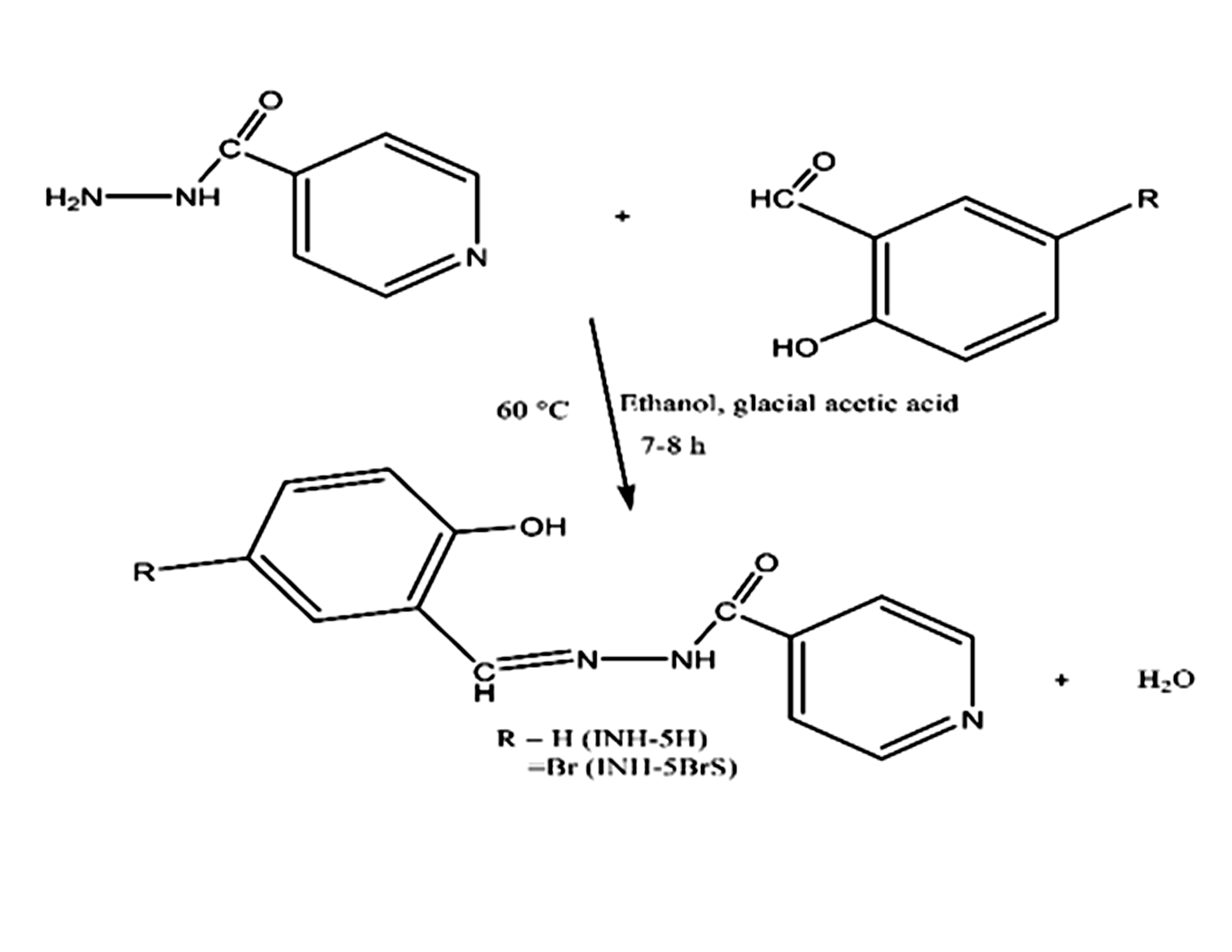
The persistent search in medicinal chemistry for active synthetic antioxidants has the goal of relieving oxidative stress-related diseases. In this study, Schiff base ligands and their corresponding metal complexes using copper, nickel, and cobalt were synthesized, with the ligands substituted with bromine (INHBrS) or unsubstituted (INH-5H). The compounds were identified using FTIR, NMR, elemental analysis and AAS (for metal complexes only). In determining the antioxidant capacity of the ligands and their corresponding metal complexes, the compounds were subjected to the DPPH, FRAP, Nitric Oxide Radical Scavenging Assay, and Total Antioxidant Capacity tests using ascorbic acid as the standard control. The study demonstrated the critical role of the nature of the substituent in the scavenging capacity of the compounds. In INH-5BrS compound, the bromine is an electron-withdrawing group due to the inductive effect (-I), resulting in a decrease in the electron density on the aromatic ring, thereby showing less antioxidant potential compared to 1NH-5H. In the 1NH-5H series, the nickel complex 1NH-5HNi has the best antioxidant capacity in the DPPH Inhibition Assay (92.345%) and the Total Antioxidant Capacity (97.4%) tests, surpassing ascorbic acid. This study provides critical insights into the structure-activity relationship (SAR) regarding inductive effects in phenolic antioxidant systems.
Downloads
Article Details

This work is licensed under a Creative Commons Attribution-NonCommercial-NoDerivatives 4.0 International License.
References
Aggoun, D., Fernández-García, M., López, D., Bouzerafa, B., Ouennoughi, Setifi, F. and Ourari, A. (2020). New nickel (II) and copper (II) bidentate Schiff base complexes, derived from dihalogenated salicylaldehyde and alkylamine: Synthesis, spectroscopic, thermogravimetry, crystallographic determination and electrochemical studies, Polyhedron, 187, 114640, DOI: https://doi.org/10.1016/j.poly.2020.114640
Akeghware, O., Avwioroko, O. J., Anigboro, A. A., & Tonukari, N. J. (2026). Comparative Bioactive Constituents And Antioxidant Capacity Of Tetrapleura Tetraptera Aqueous, Ethanolic And Methanolic Fruit Extracts. Journal of Biological Research and Biotechnology, 23(3):178-185 DOI: https://doi.org/10.4314/br.v23i3.7
Ansari, W.A., Srivastava, K., Nasibullah, M. & Khan, M. F. (2025). Reactive oxygen species (ROS): sources, generation, disease pathophysiology, and antioxidants. Discover Chemistry. 2: 191. DOI: https://doi.org/10.1007/s44371-025-00275-z
Anwar, H., Hussain, G. and Mustafa, I. (2018). Antioxidants from Natural Sources. In Antioxidants in Foods and Its Applications. InTechOpen DOI: https://doi.org/10.5772/intechopen.75961.
Awolope, R. O., Ejidike, I. P. and Clayton, S. H. (2023). Schiff base metal complexes as a dual antioxidant and antimicrobial agents. Journal of Applied Pharmaceutical Science. 13(03):132-140. DOI: https://doi.org/10.7324/JAPS.2023.91056
Bashir, B., Shehu, S., & Isah, F. (2026). Evaluation of Phytochemical and Antioxidant Properties of Musa Sapientum (Banana). Journal of Biological Research and Biotechnology, 23(3):202-207 DOI: https://doi.org/10.4314/br.v23i3.10
Chandimali, N., Bak, S. G., Park, E. H., Lim, H-J., Won, Y-S., Kim, E-K, Park, S-I. and Lee, S. J. (2025). Free radicals and their impact on health and antioxidant defenses: a review. Cell Death Discovery. 11:19. DOI: https://doi.org/10.1038/s41420-024-02278-8
Chaudhary, P., Janmeda, P., Docea, A. O., Yeskaliyeva, B., Abdull Razis, A. F., Modu, B., Calina, D. and Sharifi-Rad, J. (2023). Oxidative stress, free radicals and antioxidants: potential crosstalk in the pathophysiology of human diseases. Frontiers in Chemistry. 11:1158198. DOI: https://doi.org/10.3389/fchem.2023.1158198
Checa, J. and Aran, J. M. (2020). Reactive oxygen species: drivers of physiological and pathological processes. Journal of Inflammation Research. 13:1057–73. DOI: https://doi.org/10.2147/jir.s275595.
Dag, B., Tenekecioğlu, Y. and Aral, T. (2023). Synthesis, Characterization, and Antioxidant Activity of a Novel Schiff Base, an Amine and Amine–Metal Complexes. Russian Journal of Bioorganic Chemistry. 49:861–866. DOI: https://doi.org/10.1134/S1068162023040106
Ebrahimzadeh, M. A., Nabavi, S. M., Nabavi, S. F., Bahramian, F. and Bekhradnia, A. R. (2010). Antioxidant and free radical scavenging activity of H. officinalis L. VAR. angustifolius, V. Odorata, B. Hyrcana and C. Speciosum. Pakistan. Journal of Pharmaceutical Sciences. 23(1): 29-34
Flieger, J., Flieger, W., Baj, J., & Maciejewski, R. (2021). Antioxidants: Classification, Natural Sources, Activity/Capacity Measurements, and Usefulness for the Synthesis of Nanoparticles. Materials. 14(15):4135. DOI: https://doi.org/10.3390/ma14154135
Ghasemi, K., Ghasemi, Y. and Ebrahimzadeh, M. A. (2009). Antioxidant activity, phenol and flavonoid contents of 13 Citrus specis peels and tissues. Pakistan. Journal of Pharmaceutical Sciences. 22(3): 277-281
Green, L. C., Wagner, D. A., Glogowski, J., Skipper, P. L., Wishnok, J. S. and Tannenbaum S. R. (1982). Analysis of nitrate, nitrite, and [15N] nitrate in biological fluids. Analytical Biochemistry. 126:131–138.
Juan, C. A., Pérez de la Lastra, J. M., Plou, F. J. and Pérez-Lebeña, E. (2021). The Chemistry of Reactive Oxygen Species (ROS) Revisited: Outlining Their Role in Biological Macromolecules (DNA, Lipids and Proteins) and Induced Pathologies. International Journal of Molecular Sciences. 28: 22(9):4642. DOI: https://doi.org/10.3390/ijms22094642.
Kumar, N. and Goel, N. (2019). Phenolic acids: Natural versatile molecules with promising therapeutic applications, Biotechnology Reports, 24. DOI: https://doi.org/10.1016/j.btre.2019.e00370
Krishnamurthy, H. K., Pereira, M., Rajavelu, I., Jayaraman, V., Krishna, K., Wang, T., Bei, K. and Rajasekaran, J. J. (2024). Oxidative stress: fundamentals and advances in quantification techniques. Frontiers in Chemistry. 12:1470458. DOI: https://doi.org/10.3389/fchem.2024.1470458
Lawan, S. Y., Mshelia, M. B., Mala, G. A., Olaide, W. O., Musa, S. A., Ahmed, A. A., Yesufu, H. B. and Waziri, I. (2024). Antioxidant Activity and DFT Calculations of Metal Complexes Derived from a Schiff Base Ligand: Synthesis, Characterization, and Biological Evaluation. Chemistry Select. 9: e202400676.DOI https://doi.org/10.1002/slct.202400676
Lourenço, S. C., Moldão-Martins M and Alves, V. D. (2019). Antioxidants of Natural Plant Origins: From Sources to Food Industry Applications. Molecules. 24(22): 4132. DOI: https://doi.org/10.3390
Mensor, L., Menezes, F. and Leitao, G. 2001. Screening of Brazilian plant extracts for antioxidant activity by the use of DPPH free radical method, Phytotherapy. Research. 15: 127–130.
Mukherjee, B., Hoque, A, A., Hota, S. H., Gope, S., Ray, M., Barman, M., Bhattacharya, S., Chakrborty, S and Das, L. (2025). Antioxidants and Their Physiological Role in Free Radical Scavenging. Dietary Supplements and Nutraceuticals. DOI: https://doi.org/10.1007/978-981-97-9936-7_12-1
Panghal , M, Kumari, S., Goel, N. and Rani.I. 2023. Synthesis, Spectroscopic Characterization, Antioxidant Properties and Antimicrobial Activity of Transition Metal Complexes from Novel Schiff Base. Current Journal of Applied Science and Technology 42 (5):40-47. DOI: https://doi.org/10.9734/cjast/2023/v42i54070.
Parveen, B., Rajinikanth, V. and Narayanan, M. (2025). Natural plant antioxidants for food preservation and emerging trends in nutraceutical applications. Discover Applied Sciences. 7: 845. DOI: https://doi.org/10.1007/s42452-025-07464-6
Phaniendra, A., Jestadi, D. B. and Periyasamy, L. (2015). Free radicals: properties, sources, targets, and their implication in various diseases. Indian Journal of Clinical Biochemistry. 30:11–26. DOI: https://doi.org/10.1007/s12291-014-0446-0.
Prieto, P.; Pineda, M. and Aguilar, M. (1999). Spectrophotometric quantitation of antioxidant capacity through the formation of a phosphomolybdenum complex: Specific application to the determination of vitamin E. Analytical Biochemistry. 269: 337-341.
Pruteanu, L. L., Bailey, D. S., Grădinaru, A. C. and Jäntschi, L. (2023). The biochemistry and effectiveness of antioxidants in food, fruits, and marine algae. Antioxidants, 12(4): 860.
Rana, S., Rayhan, N. M. A., Emon, S. H., Hasan, M., Mansur, M. I., Srijon, B. C., Islam, S., Ray, A., Islam, A., Kudrat-E-Zahan, K., Hossen, F., and Asraf, A. (2024). Antioxidant activity of Schiff base ligands using the DPPH scavenging assay: an updated review, RSC Advances. 14: 33094-33123.
Rasheed, A. and Fathima Abdul Azeez, R. (2019). A Review on Natural Antioxidants. In Traditional and Complementary Medicine. IntechOpen. 82636. DOI: https://doi.org/10.5772/intechopen.82636
Sies H., Belousov, V. V., Chandel, N. S., Davies, M. J., Jones, D. P., Mann, G. E., Murphy, M. P., Yamamoto, M. and Winterbourn, C. 2022). Defining roles of specific reactive oxygen species (ROS) in cell biology and physiology. Nature Reviews Molecular Cell Biololgy. 23:499–515. DOI: https://do i.org/10.1038/s41580-022-00456-z.
Silverman, R. B.; Holladay, M. W. (2014). The Organic Chemistry of Drug Design and Drug Action, 3rd ed.; Academic Press: London, pp 522
Thanuja B., Kripa, K. G., Thiyagarajan B. and Kanagam. (2022).The Effect of Substituents and Functional Groups on Enhancing the Antioxidant Activity of Benzoin Derivatives. Current Chemical Biology, 16(1), 70-80. DOI: https://do i.org/10.2174/2212796816666220517103230
Usoro, E. (2024). Comparative Analysis of Natural vs. Synthetic Antioxidants in Nigeria. Journal of Chemistry, 3(3), 27-37.
Yen, G. C. and Chen, H. Y. (1995). Antioxidant activity of various teas extracts in relation to their anti-mutagenicity. Journal of Agricultural and Food Chemistry. 43: 27–32.