

Phytochemical Profile and Antibacterial Activity of Vernonia amygdalina Leaf Extracts against Bovine Mastitis Pathogens
Article Sidebar
Main Article Content
Abstract
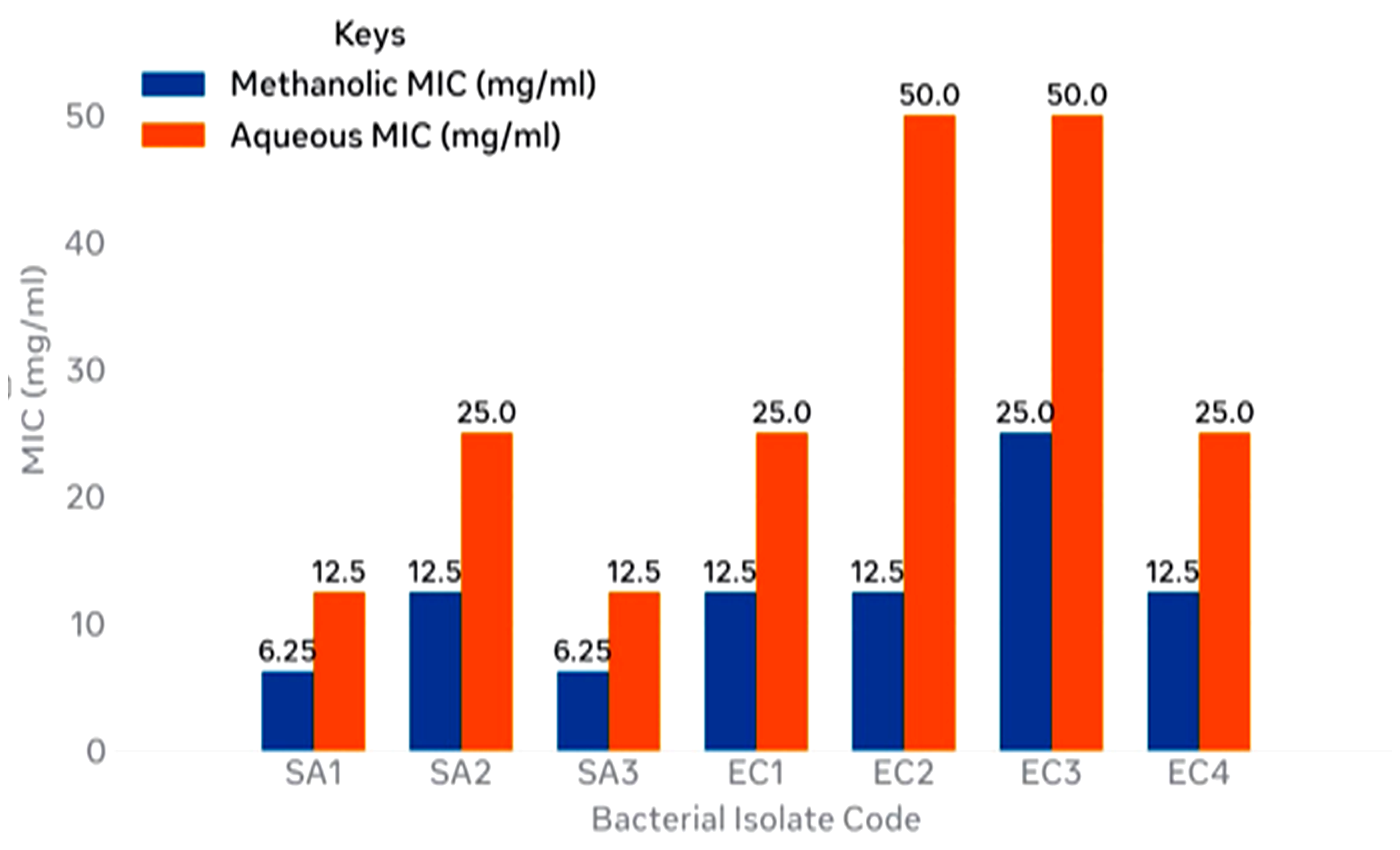
Vernonia amygdalina remains a veritable ethnoveterinary plant used for the treatment of bovine mastitis. In this study, 4 (4%) isolates of Escherichia coli and 3 (3%) of Staphylococcus aureus were recovered from a total of 100 bovine milk samples screened.In this study, 4 (4%) isolates of E. coli and 3 (3%) of S. aureus were detected from a total of 100 milk samples screened. Phytochemical analysis conductedrevealed dense profile of bioactive compounds among which are: flavonoid, saponin, alkaloid, glycoside, terpenoid, tannins, steroids, phenolic compound, anthraquinones and volatile oil. Crude methanolic leaf extract demonstrated better phytochemical richness and exhibited significantly higher zones of inhibition range (6.00 ± 0.00 - 24.4 ± 0.84 mm) compared to the aqueous extract (0.0 ± 0.0 - 18.22 ± 1.12 mm) at 12.5 - 100 mg/mL. One-way Analysis of Variance (ANOVA) revealed a statistically significant difference in the zones of inhibition across the four concentrations for both methanolic (p < 0.05) and aqueous (p < 0.05) extracts. The Minimum Inhibitory Concentration (MIC) ranged from 6.25 - 12.5 mg/mL for S. aureus and 12.5 – 25 mg/mL for E. coli in the methanolic extract, while the aqueous MIC range was 12.5 - 50 mg/mL for S. aureus and 25 – 50 mg/mL for E. coli isolates. The Minimum Bactericidal Concentration (MBC) values were 12.5-50 mg/mL in the methanolic extract and 25-100mg/mL in the aqueous extract, implying an MBC 1-2 fold higher than MIC, indicating bactericidal action at higher concentrations. The plant showed promise as a source of alternative therapy for bovine mastitis, but further purification, toxicity and in vivo studies are recommended.
Downloads
Article Details

This work is licensed under a Creative Commons Attribution-NonCommercial-NoDerivatives 4.0 International License.
References
Abebe, R., Markos, A., Abera, M. and Mekbib, B. (2023). Incidence Rate, Risk Factors, and B5acterial causes of Clinical Mastitis on Dairy Farms in Hawassa City. Southern Ethiopia. Scientific Report. 13: 10945. https://doi.org/10.1038/s41598-023-37328-1
Abubakar, M.B., Ahmad, K.H., Umar, B.N., Salawudeen, M.T., Olorunshola, I.D. and Usman, M.D. (2022). Haemolytic and Antibiogram Activities of Staphylococcus aureus Isolated from Cattle with Mastitis in Sokoto, Northern Nigeria. Journal of Sustainable Veterinary and Allied Science. 3(1):39-42.http://doi.org/10.54328/covm.josvas.2022.086
Adewuyi, H.A. (2025). Phytochemical and Nutritional Composition of Vernonia amygdalina: Antioxidant, Antidiabetic Efficacy, and Hematological Benefits. Pharmacology and Clinical Pharmacy Research 10(2):127-137. DOI:10.15416/pcpr.v10i2.59067
Ahmad, K. H., Musa, M., Umar, B. N., Zubair, F. Z., Musa, MA. S. A., Fasogbon, I. V., Widodo, A., Wahyuni, R. M., &Dharianta, R. (2026). Bovine Mastitis in Nigeria: A High Burden of Phenotypically Characterized Methicillin- Resistant Staphylococcus aureus. Advances in Animal and Veterinary Sciences, 14(6), 1366-1371. https://doi.org/10.17582/journal.aavs/2026/14.6.1366.1371
Adamu, H. S., Hussaini, R. O., Cedric, Obasuyi, L. I, A., and Okoduwa, G. O. (2020). Prevalence of mastitis in Nigerian livestock: De Gruyter.1: 20–29. https://doi.org/10.1515/ovs-2020-0101
Ágredo-Campos, A. S., Ramírez, N., and Fernández-Silva, J. A. (2023). Staphylococcus aureus, Escherichia coli, and Klebsiella spp. prevalence in bulk tank milk of Colombian `Herds and Associated Milking Practices. Veterinary World. 16(4):868–876. DOI:10.14202/vetworld.2023.868-876
Alebachew, T. and Aylate, A. (2015). Prevalence of Bovine Mastitis in Lactating Cows and its Public Health Implications in Selected Commercial Dairy Farms of Addis Ababa. Global Journal of Medical Research: Veterinary Science and Veterinary Medicine. 15(2):1-9. http://creativecommons.org/licenses/by-nc/3.0/
Anueyiagu, K. N., Agusi, E. R., Kabantiyok, D., Ayanbimpe, G. M., and Ikeh, E. I. (2025). Zoonotic Potential of ESBL-producing Coliforms in Pastorally Managed Ruminants with Subclinical Mastitis in Plateau State, Nigeria. Frontiers in Antibiotics. 4: 1632264. https://doi.org/10.3389/frabi.2025.1632264.
Aryl, S. (2024). Staphylococcus aureus morphology, Characteristics, Infections and Virulence. Bacteriology. Sourced online from: https://microbenotes.com/Staphylococcus-aureus 30th December 2025.
Bala, J.D., Ishaleku, D., and Bello, M. (2018). Microbiological quality assessment of raw salad vegetables in Minna, Nigeria. Journal of Bio-Science, 25, 1–7. https://doi.org/10.3329/jbs.v25i0.37491
Bolajoko, M. B., Van Gool, F., Peters, A. R., Martinez, J. S., Vance, C. J., and Dungu, B. (2020). Field Survey of Major Infectious and Reproductive Diseases Responsible for Mortality and Productivity Losses of Ruminants amongst Nigerian Fulani Pastoralists. Gates Open Research, 4(162): 1-16. https://doi.org/10.12688/gatesopenres.13164.1
Centers for Disease Control and Prevention. (2024). About Staph food Poisoning. U.S. Department of Health and Human Services. Sourced online from: https://www.cdc.gov/staph-food-poisoning/about/index.htmL on 11th May 2025.
Cheng, W. N., and Han, S. G. (2020). Bovine mastitis: risk factors, therapeutic strategies, and alternative treatments - A review. Asian-Australasian journal of animal sciences, 33(11), 1699–1713. https://doi.org/10.5713/ajas.20.0156
Clinical and Laboratory Standards Institute (CLSI) (2020). Performance Standards for Antimicrobial Susceptibility Testing.22nd Information Supplement.M100-S22. Pg 49-80. Sourced online from: http//antimicrobianos.com on 15th October, 2025
Cobirka, M., Tancin, V. and Slama, P. (2020). Epidemiology and Classification of Mastitis in Animals: An Open Access Journal from MDPI. 10(12): 2212 https://doi.org/10.3390/ani10122212
Dego, O. K. (2021). Current Status of Antimicrobial Resistance and Prospect for New Vaccines against Major Bacterial Bovine Mastitis Pathogens. In Animal Reproduction in Veterinary Medicine. IntechOpen. https://doi.org/10.5772/intechopen.94227
Doughari, J. H. (2012). Phytochemicals: Extraction Methods, Basic Structures and Mode of Action as Potential Chemotherapeutic Agents. In book: Phytochemicals - A Global Perspective of Their Role in Nutrition and Health. DOI:10.5772/26052
Faul, F., Erdfelder, E., Buchner, A. and Lang, A.G. (2009). Statistical Power Analyses using GPower 3.1: Tests for Correlation and Regression Analyses. Behavior Research Methods, 41(4): 1149–1160. DOI:10.3758/BRM.41.4.1149
Fitri, Z. A., Ahmadi, F., Islam, M. A., Ponnampalam, E. N., Dunshea, F. R. and Suleria, H. A. R. (2025). A Systematic Review of Extraction Methods, Phytochemicals, and Food Applications of Moringaoleifera Leaves Using PRISMA Methodology. Food science & nutrition. 13(4): e70138. https://doi.org/10.1002/fsn3.70138
Forster, A., and Walsh, J. (2017). Extraction Methodologies and Solvent Selection in Phytochemical Analysis. Journal of Chemical and Pharmaceutical Sciences. 10(3): 1245–1252. https://www.scimagojr.com/journalsearch.php?q=19700201516&tip=sid
Garga, M. A. (2017). Antibacterial Activity and Phytochemical Screening of Moringaoleifera Leaves and Seeds extract on some Selected Clinical Bacterial Isolates. A Master of Science (M.Sc.) Degree Dissertation of the Department of Microbiology, UsmanuDanfodiyo University, Sokoto. Pg. 26-28
Günther, J., Petzl, W., Zerbe, H., Schuberth, H. J., Seyfert, H. M., and Seyfert, H. M. (2017). Pathogen-specific Responses in the Bovine Udder. Models and Mechanisms. Research in Veterinary Science. 112: 119–125. https://linkinghub.elsevier.com/retrieve/pii/S0034528817309414
Habtamu, A. and Melaku, Y. (2018). Antibacterial and antioxidant compounds from the flower extracts of Vernonia amygdalina.Advances in Pharmacological Sciences. 2018: 4083736. https://doi.org/10.1155/2018/4083736
Heston, T. F. (2023). The Robustness Index: Going Beyond Statistical Significance by Quantifying Fragility. Cureus, 15(8), e44397. DOI: https://doi.org/10.7759/cureus.44397
Hillerton, J. E. and Booth, J. M. (2020). Whatever happened to mastitis pathogenesis? Journal of Dairy Research, 87(1): 4-10.DOI: 10.1017/S002202992000074
Hossain, M.K., Paul, S., Hossain, M.M., Islam, M.R. and Alam, M.G.S. (2017). Bovine Mastitis and Its Therapeutic Strategy during Antibiotic Sensitivity Test. Austin Journal of Veterinary Science &Animal Husbandry. 4(1):1030-1042. http://www.austinpublishinggroup.com/
Ibrahim, A. A., Mohammed, A. K., Hassan, M. R., and Abdulsalam, H. (2018). Milk yield losses and Cost of Clinical Mastitis in Friesian × Bunaji Crossbred Cows in Zaria, Nigeria. Sokoto Journal of Veterinary Sciences. 16(4): 48-55. DOI:10.4314/sokjvs.v16i4.7
Iraguha, B. (2024). Bovine Mastitis Control Strategies with Emphasis on Developing Countries. In Veterinary Medicine and Science. IntechOpen. Sourced Online at https://doi.org/10.5772/intechopen.112348
Jarmai, A. H., Sheikh, A. M., Onyiche, T. E., Yunus, H., Aji, M. A. and Umar, S. M. (2022). Antimicrobial Activity and Phytochemical Screening of Methanolic Leaf Extract of Vernonia amygdalina. South Asian Journal of Research in Microbiology. 14(1): 26-35.https://doi.org/10.9734/sajrm%2F2022%2Fv14i1263
Magaji, A. (2026).Phytochemical Screening, Antibacterial Efficacy and Acute Oral Toxicity Evaluation of Methanolic and Aqueous Vernonia amygdalina Leaf Extracts against Selected Bacterial Isolates.Nigerian Journal of Biotechnology and Life Sciences. 3(2):168-172. DOI:10.67601/njbls.v3i2.46
Maryam, S. I., Abdulsalam, H., Namadina, M. M., Yunusa, A. Y., &Shehu, S. A. (2024). Phytochemical, Antioxidant and Antibacterial Activities of Vernonia amygdalina Del. Leaf Extract. Biological and Environmental Sciences Journal for the Tropics. 21(1): 1–11. DOI: 10.4314/bestj.v21i1.1
Merem, E. C., Twumasi, Y. A., Wesley, J., Alsarari, M., Fageirin, S., Crisler, M., Romorno, C., Olagbegi, D., Hines, A., Ochai, G. S., Nwagboso, E., &Mussa, M. (2022). The Analysis of Dairy Production and Milk Use in Africa Using GIS. Food and Public Health. 12(1): 19-41.DOI:10.5923/j.fph.20221201.03
Morales-Ubaldo, A. L., Rivero-Perez, N., Valladares-Carranza, B., Velázquez-Ordoñez, V., Delgadillo-Ruiz, L., & Zaragoza-Bastida, A. (2023). Bovine Mastitis, a Worldwide Impact Disease: Prevalence, Antimicrobial Resistance and Viable Alternative Approaches. Veterinary and Animal Science. 21: 300-306. https://doi.org/10.1016/j.vas.2023.100306
More, S.J., McAloon, C., Silva, B. P., O'Grady, L., O'Sullivan, F., McGrath, M., Buckley, W., Downing, K., Kelly, P., Ryan, E.G. and McCoy, F. (2022). Mastitis Control and Intramammary Antimicrobial Stewardship in Ireland: Challenges and Opportunities.Frontiers in Veterinary Science. 9:748353. doi: 10.3389/fvets.2022.748353he Milk Marketing Board
Moru, N.H., Umoh, J.U., Maikai, B.V., Barje, P.P. &Amuta, P. (2018). Milk Yield Losses and Cost of Clinical Mastitis in Friesian × Bunaji Crossbred Dairy Cows in Zaria, Nigeria. Sokoto Journal of Veterinary Sciences. 16(2): 28 - 34. http://dx.doi.org/10.4314/sokjvs.v16i2.4
Musyoki, D. (2024). Exploring the Antibacterial Properties of Vernonia amygdalina (Bitter Leaf) Extract: A Potential Alternative to Conventional Antibiotics. Newport International Journal of Biological and Applied Sciences. 5(1): 60-67. https://doi.org/10.59298/NIJBAS/2024/5.1.606711
Muturi, E. W. (2020). Effect of Mastitis on Milk Production in Dairy Cows in Kenya. Journal of Animal Health. 2(1):85-91
National population commission (2017). Knowledge of Family Planning Method and 2006 population and housing Census of the Federal Republic of Nigeria. Zamfara State. Priority Table volume 1. Abuja, NPC. Pg. 22-34. Sourced online from: https://nationalpopulation.gov.ng/
National Research Council-NRC. (2011). Guide for the Care and Use of Laboratory Animals(8th edition). Washington, DC: The National Academies Press. doi: 10.17226/12910
Ndivhuwo, R. (2020). Characterization of E. coli and Staphylococcus aureus Isolated from Clinical and Subclinical Bovine Mastitis in a Limpopo Dairy Farm, South Africa. University of Venda (Master's Dissertation). Sourced online from: http://hdl.handle.net/11602/1548 on6 22nd September 2025.
Noor, S., Shathan, A., &Najjar, A. (2026). In Vitro Evaluation of Ethanolic Medicinal Plant Extracts from the Aseer Region against Selected Cultured Oral Bacterial Isolates from Healthy Volunteers. Microorganisms. 14(2): 499. https://doi.org/10.3390/microorganisms14020499
Obioha, J., Obum-Nnadi, C. N., Ezenwa, C. M., Amaechi, D. and Ohabughiro, N. B. (2023). Phytochemical and antibacterial activities of Vernonia amygdalina leaves against Selected Clinical Pathogens. Current Research in Interdisciplinary Studies, 2(1), 12–21. DOI: 10.5281/zenodo.7876123
Obialo, C. J., Kolawole, A. E., and Adetola, J. O. (2024). Phytochemical Screening, Proximate Analysis, and Antimicrobial Evaluation of Selected Medicinal Plant Extracts. Journal of Advances in Medical and Pharmaceutical Sciences. 26(4): 12-25. doi:10.9734/jamps/2024/v26i4682
Onyema-Ilo, B. O., Onah, C. E., Meludu, S. C., Dioka, C. E., and Ogbuagu, E. O. (2018). Evaluation of the phytochemical constituents and safety profiles of methanolic leaf extract of Vernonia amygdalina in Nnewi metropolis. Journal of Medical Laboratory Science. 28(2): 45–56. doi: 10.4314/jmLs.v28i2.6
Oseghale, V., David, I., Lawal, O. P. and Ubebe, D. O. (2024). Ethnomedicinal and Phytopharmacological Aspects of Vernonia amygdalina (Bitter Leaf) Utilized as a Traditional Medicinal Herb. Asian Journal of Research in Biochemistry. 14(6): 41–57.http://dx.doi.org/10.9734/ajrb/2024/v14i6326.
Raji, M., Amoo, F. K., Adeniyi, K. A., Amoo, A. O., Abdulrahman, M. I., Mukthar, I. S., Baita, N., Adeleye, A. O., & Abba, S. Y. (2025). Antibacterial Activity of Bitter Leaf (Vernonia amygdalina) Extracts on Escherichia coli and Staphylococcus aureus. FUDMA Journal of Sciences. 9(4): 15–160. doi: https://doi.org/10.33003/fjs-2025-0904-3344
Robledo-Díaz, Y.L., Sánchez-Varón, A.A., Van-arcken-Aguilar, Y.C., Sánchez-Bonilla, M.D.P. and Hernández-Carvajal, J.E. (2025). In Vitro Antibacterial Activity of Ethanolic Extracts Obtained from Plants Grown in Tolima, Colombia, against Bacteria Associated with Bovine Mastitis. Veterinary Science. 12: 903-906. https://doi.org/10.3390/vetsci1209090310.3390/vetsci12090903
Robi, D. T., Teklemariam, T., Gebreyes, B. G., Bogale, A., Haile, T., Aleme, M., Temteme, S. and Beksisa U. (2026). Epidemiology and antimicrobial resistance of Staphylococcus aureus and Escherichia coli in bovine mastitis in Southwest Ethiopia, Preventive Veterinary Medicine: Regional Studies and Reports. 1(3): 100048. https://doi.org/10.1016/j.pvmrsr.2026.100048.
Ruegg, P. L. (2017). A 100-Year Review: Mastitis Detection, Management, and Prevention. Journal of Dairy Science. 100(12): 10381–10397. https://doi.org/10.3168/jds.2017-13023
Santos, V. M., Martins, H. B., Rezende, I. S., Barbosa, S. S., Andrade, E. F., Souza, S. G., Campos, G. B., Oliveira, P. S., Sousa, D. S., Da Silva, D. C. C., Amorim, A. T., Timenetsky, J., Cruz, M. P., Yatsuda, R., & Marques, L. M. (2014). Virulence Factor Profile of Staphylococcus aureusIsolated from Bovine Milk from Brazil. Food and Nutrition Sciences. 5(15): 1496-1505.doi:10.4236/fns.2014.515162
Shamsudin, N. F., Ahmed, Q. U., Mahmood, S., Ali Shah, S. A., Khatib, A., Mukhtar, S., Alsharif, M. A., Parveen, H., &Zakaria, Z. A. (2022). Antibacterial Effects of Flavonoids and Their Structure-Activity Relationship Study: A Comparative Interpretation. Molecules (Basel, Switzerland). 27(4): 1149. https://doi.org/10.3390/molecules27041149
Sharma, N., Singh, N. K., and Bhadwal, M. S. (2011). Relationship of Somatic Cell Count and Mastitis: An Overview. Asian-Australasian Journal of Animal Sciences. 24(3): 429-438.https://doi.org/10.5713/ajas.2011.10233
Thaker, H.C., Brahmbhatt, M.N. and Nayak, J.B. (2013). Isolation and Identification of Staphylococcus aureus from Milk `and Milk Products and their Drug Resistance Patterns in Anand, Gujarat. Vet World. 6(1):10-13. doi:10.5455/vetworld.2013.10-13
Ugbogu, E. A., Emmanuel, O. D., Emmanuel, D., Agi, G. O., Ugbogu, O. C., Ibe, C. and Iweala, E. J. (2021). The Phytochemistry, Ethnobotanical, and Pharmacological Potentials of the Medicinal Plant-Vernonia amygdalina L. (bitter Leaf). 1(1): 1-16. Available From Sheffield Hallam University Research Archive (Shura) At: Https://Shura.Shu.Ac.Uk/29150/
Umar, A., Whong, C. M. Z., Abdullahi, I. O. and Falana, M. B. (2023). An Assessment of the Risk Factors Associated with Subclinical Mastitis in Small Holder Dairy Cows and Large Mechanized Dairy Cows in Parts of Kaduna State, Nigeria. Environmental Science Climate Research. 1(1):46-52.https://opastpublishers.com/.